
New Study Confirms Ideal Protein Intake Range for People with CKD Stage 3 or 4
And why going too low or too high can do more harm than good
If you're living with Chronic Kidney Disease (CKD) Stage 3 or 4, you've probably heard that “less protein is better.” But how much is too little? And what if you're eating too much?
A recent study brings clarity to this important topic, and the findings are crucial:
Both too little (<0.6 g/kg of body weight/day) and too much (>1.3 g/kg/day) dietary protein can negatively impact your kidney health.
The guideline – 0.8 g/kg/day
The most recent Kidney Disease Improving Global Outcomes (KDIGO) guidelines recommend:
Aim for: 0.8 g/kg/day
Never exceed: 1.3 g/kg/day
This number helps strike a balance: protecting kidney function without risking malnutrition.
Many doctors still use the older 0.6 g/kg/day minimum as a blanket guideline. But new research shows that 0.8 g/kg/day is more appropriate for people in CKD Stage 3 or 4—especially if you’re active or at risk of losing muscle.
How to Calculate Your Ideal Protein Intake
Here’s a simple way to find your range:
Let’s say you weigh:
70 kg (154 lbs)
➤ Multiply by 0.8
➤ 70 × 0.8 = 56 grams of protein per day
If you're in the U.S. and weigh yourself in pounds:
Convert pounds to kilograms:
➤ Weight (lbs) ÷ 2.2 = weight in kgMultiply by 0.8 g
Example:
154 lbs ÷ 2.2 = 70 kg
70 × 0.8 = 56 grams/day
Now you have your target. But how do you track it easily?
Real-life Support: How MetaSano Helps You Stay in Range
One of the things we love about MetaSano is how it transforms complex science into clear, visual feedback during your daily meals.
For example:
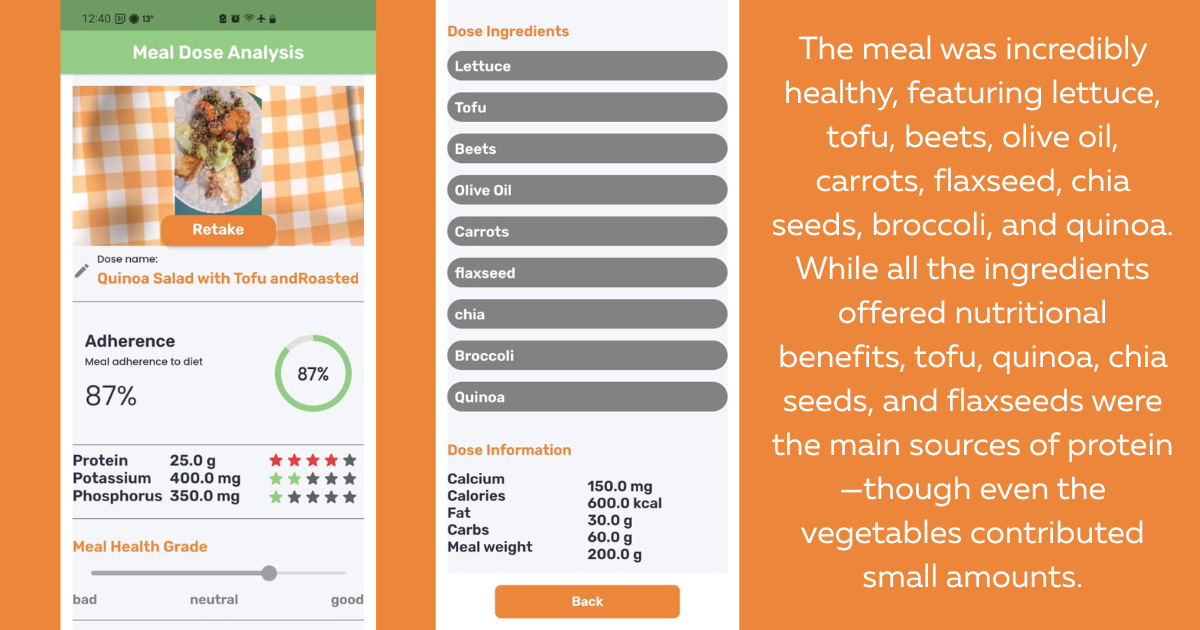
If your lunch is high in protein, MetaSano will show 3–4 red stars, letting you know you're approaching the upper limit.
If you’ve had very little protein, below 0.6 g/kg, you’ll see few stars, indicating a possible risk of malnutrition.
👩🍳 One of our users sent us a picture of her lunch—it showed 4 red stars!
Her lunch alone made up 50% of her daily protein intake—and she had already had breakfast, with an afternoon snack and dinner still to come. That meant she needed to stay mindful for the rest of the day to avoid going over her recommended limit.
If you're already using the MetaSano app, make sure you've downloaded the latest version. Then, update your weight by going to the Log tab and selecting Weight.
If you haven’t downloaded MetaSano yet, just head to your phone’s app store, search for MetaSano, and install the latest version.
MetaSano = More Than Tracking. It Keeps You Updated.
Science evolves—and with MetaSano, so do you. Many healthcare professionals still recommend outdated values, but MetaSano integrates the latest guidelines and studies right into your daily tracking.
This means:
✔️ You stay on top of your health
✔️ You get real-time alerts when you’re over or under
✔️ You can discuss accurate, science-backed insights with your doctor
Study reference: Dietary Protein Intake Recommendations for Patients with Non-Dialysis-Dependent CKD: What Should Healthcare Providers Do?
Have you checked your protein intake lately?
Reply to this post or share your meal with MetaSano. Let's learn together, live better, and slow CKD progression—one smart meal at a time.
Until next week,
Ewerton Lopes - Living with CKD since 2016
CEO of MetaSano
Integrative Nutrition Specialist
Kidney Health Coach
Member of the Quebec Nephrology Society
Gerontologist
🔗 Not using MetaSano yet?
Join the food-as-medicine movement and take control of your kidney health.
👉 Download MetaSano now